
Breaking the Silence: EHC brings the voices of women and girls with bleeding disorders to the European Parliament

From 17 to 19 November 2026, the European Haemophilia Consortium (EHC) organised an exhibition on women and girls with bleeding disorders at the European Parliament in Brussels and, on 17 November, held the Round Table “Breaking the Silence” right after the exhibition opening event. Patients, clinicians, patient organisation representatives, and policymakers came together to discuss why diagnosis comes so late, what living with a bleeding disorder means across a woman’s life, and what the European Union (EU) can do to improve access to timely diagnosis, appropriate care, and support.
Key takeaways
- Across Europe, women and girls with bleeding disorders often wait years for a diagnosis, and heavy menstrual bleeding is too often dismissed as “normal”. Studies cite a median diagnostic delay of 8-16 years.
- The work starts in first-line care: gynaecologists, midwives, and general practitioners must learn to see heavy menstrual bleeding as a potential sign of a bleeding disorder, and to screen for it.
- The EHC presented six policy recommendations for the EU, from equitable access to care to embedding women’s health in EU policy.
An exhibition that puts women and girls at the centre
Hosted by MEP Nicolás González Casares (S&D, Spain), the EHC exhibition opened on 17 November at 12:30 PM in the Spinelli building, 3rd floor (3D). Through personal stories, informative visuals, and educational materials, it aims to raise awareness of bleeding disorders in women and girls, challenge common misconceptions, and promote better recognition of menstrual and bleeding disorders.
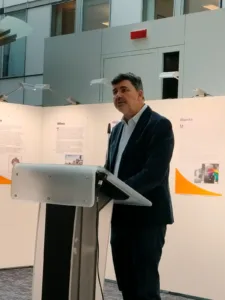
MEP González Casares opened the exhibition with a welcome speech, underlining the importance of a gender perspective in health policy and of listening to women.
EHC President Tatjana Marković presented the EHC, and Brina Zaman, Chair of the EHC Women and Bleeding Disorders (WBD) Committee, presented the Committee’s work and the caregiver perspective. “Before we can change something, we need to acknowledge that a problem exists,” she said. “We want women with bleeding disorders of all ages and experiences to feel seen and heard. Visibility is important, but it must lead to action.”
Dr Maria Elisa Mancuso, Chair of the EHC Medical Advisory Group (MAG), offered clinical insights and underlined the value of collaboration: “When haematologists and gynaecologists work together, it’s a win-win. We can improve the lives of women with bleeding disorders.”
Round Table: why does diagnosis take so long?
The Round Table “Women and Girls with Bleeding Disorders: Breaking the Silence” took place on 17 November from 14:00 to 16:00 in Room Spinelli 1G369, opened by EHC President Tatjana Marković.
In the session on early diagnosis, Dr Maria Elisa Mancuso and Dr Hortense Maynadié (Hôpital Bicêtre, Paris, France) showed that bleeding disorders in women and girls are not rare, but are still likely to be underdiagnosed.
The clinicians highlighted several clues that can speed up diagnosis:
- Heavy menstrual bleeding. A case comparison built from Dutch study data showed a boy and a girl with the same disease, von Willebrand Disease (VWD), and the same age at first bleed: 11. He was diagnosed at 17, while she was diagnosed at 21, four years later, because her heavy periods did not trigger screening for a bleeding disorder.
- Iron deficiency. In a Swedish study of school girls, 52% of those with heavy menstrual bleeding had iron deficiency, compared with 26% of those without. Iron deficiency is an objective warning sign that is easy to check: a haemoglobin and ferritin blood test is cheap, widely available, and gives results within 24 hours.
- Symptoms beyond periods. Haemorrhagic ovarian cysts, bleeding after gynaecological procedures or intercourse, and postpartum haemorrhage can also signal a bleeding disorder.
Patient advocates Eke Hullegie and Audrey Renkin, both members of the EHC WBD Committee, shared what it means to live with a bleeding disorder at different stages of life.
Audrey described heavy bleeding from her first periods, the toll of recurrent bleeding on her working life, how prophylaxis finally gave her more stability, and the new challenges that came with perimenopause. Eke, a carrier of haemophilia, recalled growing up believing her long, heavy periods were simply bad luck, and the turning point when women with low factor levels were finally recognised as patients, with regular follow-up and a treatment plan. Their message was clear: heavy periods are still too often considered normal, and women must be listened to from the first period onwards.
EHC WBD Committee Chair Brina Zaman emphasised that women with bleeding disorders are not only carriers or caregivers: they are patients too, and need regular follow-up and their own treatment plans. She presented resources developed by the WBD Committee, including the “10 Facts about Women with Bleeding Disorders” factsheet and the 7-2-1 rule for recognising heavy periods.
The closing discussion focused on what Europe can do. The EHC’s policy recommendations call for the EU to:
- Improve access to care, with equitable diagnosis and treatment for all women and girls, including through the revised Pharmaceutical Legislation.
- Incentivise EU research, with Horizon Europe and future EU funding for women and rare bleeding disorders.
- Strengthen early diagnosis through EU-wide awareness campaigns, screening, and training for healthcare professionals.
- Foster multidisciplinary care, linking haematologists, gynaecologists, geneticists, and primary care.
- Support data collection, with gender-sensitive registries and the European Health Data Space.
- Embed women’s health in EU policy, through gender mainstreaming across EU legislation.
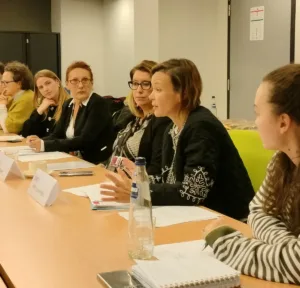
Closing the Round Table, MEP Leire Pajín (S&D, Spain) called on Europe to break the silence around women’s pain, which is too often seen as normal, and to do more so that every woman gets the right care at the right time, with more research and better care for women. She also highlighted the role of patient organisations in bringing experiences together and helping policymakers make better decisions.
Resources to share
- 10 Facts about Women with Bleeding Disorders: an evidence-based advocacy toolkit
- Heavy periods and the 7-2-1 rule: infographic, factsheet, and blood loss chart
- EHC WBD Committee


